 Sandridgebury Lane, St Albans, Hertfordshire, AL3 6DB


Mathematics
Curriculum Intent and Overview
We aim to deliver high quality lessons which inspire, instill confidence and motivate all learners to achieve their best. All our enthusiastic students are able to apply Mathematics in real life situations without limitations or stereotypes.
The Department
Curriculum Leader: Mrs L Berks
Deputy Curriculum Leader: Miss B Soler
KS4 Coordinator: Mrs H Rock
KS3 Coordinator: Mrs S Maghsoudi
Key Stage 3
What will be studied?
In year 7 and 8, we focus on building students’ understanding of Mathematical concepts, introducing algebraic thinking and geometric reasoning. These skills are applied throughout to solve a range of related problems. The level of challenge is high and learning is modelled using a variety of approaches and strategies designed to help students develop understanding. Our programme of study is adapted from the White Rose Scheme of Learning to ensure it meets the needs of our students. Students are organised into broad bands based on prior attainment and teacher assessment. The Year 9 scheme of learning builds on the Year 7 and 8 content and students will consolidate and extend this understanding as well as encountering some new concepts and topics, ensuring they are fully prepared for Key Stage 4.
Year 7
Autumn
Sequences
Geometric construction
Directed numbers
Algebraic notation
Equations
Properties of number
Spring
Developing understanding of calculations
Understanding fractions, decimals & percentages
Area and perimeter
Summer
Adding and subtracting fractions
Geometric reasoning
Probability
Statistical diagrams
Year 8
Autumn
Ratio
Multiplicative reasoning
Multiplying and dividing fractions
The Cartesian Plane
Probability diagrams
Indices
Algebraic expressions
Spring
Linear sequences
Percentages
Equations
Standard Index Form
Summer
Angles in parallel lines & polygons
Areas & perimeter of polygons and circles
Statistical diagrams
Averages & measures of spread
Year 9
Autumn
Number
Straight Line Graphs
Equations, formulae & inequalities
3D Shapes
Constructions and Congruency
Spring
Using Percentages
Geometrical reasoning
Pythagoras' Theorem
Rotation, reflection & translation
Summer
Enlargement and similarity
Ratio and proportion
Compound measures
Probability
Expanding and factorising quadratic expressions
Students are encouraged to enter the UKMT Maths Challenges which allows them to test their problem-solving skills in a national competition. Our students regularly receive Gold awards and in recent years we have had students qualify for Olympiads as a result of exceptional performance in these challenges. Students in year 7 and 8 have the opportunity to represent the school in the Hertfordshire Maths Competition.
How can I support my child?
- Mathswatch has a range of explanatory videos and home learning tasks to support the learning taking place in class
- Dr Frost Maths has all of our courses available to students who are logged in, and they can practice key skills and watch videos to support their learning
- Encourage your child to practice their mental maths regularly by asking them what the time is, how much something will cost, how much change to expect etc.
- Encourage them to attend Maths Study Clubs to ask questions and get support from their class teacher, or to attend Puzzle Club to develop their skills of logical deduction and spatial reasoning.
How are students assessed at Key Stage 3?
- Regular skills quizzes
- In lessons students will be assessed by questioning, classwork and home learning tasks
- Half-termly assessment assessing the recent units of work
What equipment is needed?
It is essential that students have a pen, pencil, ruler, eraser, protractor and pair of compasses for all Maths lessons.
The recommended calculator for students in Years 7, 8 & 9 is the Casio fx-83GT CW+. Please note, there is also a calculator named the Casio fx-83GT CW (it does not have the + in the name), this is the previous generation of this calculator. The newer generation of the calculator has slightly better functionality but a student will not be at a disadvantage if they have the older model.
GCSE
Exam Board: Edexcel
Specification Number: 1MA1
What will be studied?
At GCSE we follow the Edexcel GCSE curriculum for Mathematics. The GCSE Mathematics curriculum builds on previous learning in the areas of Number, Algebra, Ratio, Proportion and Rates of Change, Geometry and Measures, Probability and Statistics.
Students learn to use and apply standard mathematical techniques, reason, interpret and communicate mathematically and solve problems within Mathematics and other contexts.
The highest attaining students are offered the opportunity to take part in the UKMT challenges. These build resilience and a chance for students to develop their problem solving skills. Successful students will be awarded with a Bronze, Silver or Gold certificate and could be asked to progress to the next round.
Students on course for a grade 8 or 9 will be given the opportunity to study for the Edexcel Level 3 Certificate in Algebra which offers them an opportunity to explore concepts found in A Level Maths and Further Maths. This qualification strengthens advanced algebraic understanding which both supports high attainment at GCSE and prepares students for A Level study.
How is the course assessed?
The GCCE Maths course is assessed through three equally-weighted written exam papers at the end of Year 11. Each paper is 1 hour and 30 minutes long and has 80 marks available. Paper 1 is a non-calculator assessment and a calculator is allowed for Paper 2 and Paper 3. The content of the specification can be assessed in any of the three papers. Students are entered for either the Foundation Tier or Higher Tier examinations; the tier of entry is not finalised until after the mock exams in Year 11.
Throughout the course we have approximately half-termly internal assessments based closely on exam-board materials to help identify areas of success and areas for improvement; these do not contribute to a final grade.
What texts are recommended?
Students are provided with access to an online Edexcel textbook, Purposeful Practice. There are also many excellent online resources available to students.
We also recommend the following books for students interested in wider reading around the subject:
- Alex’s Adventures in Numberland - Alex Bellos
- The Curious Incident of the Dog in the Night Time - Mark Haddon
- Fermat’s Last Theorem – Simon Singh
- Humble Pi – Matt Parker
These books are all available in our school library.
What websites are recommended?
What websites are recommended?
MathsWatch has a range of videos to explain new topics as well as revise previous ones
Google Classroom includes resources used for lessons and home learning, as well as revision resources
Corbettmaths provides alternative videos to MathsWatch, as well as sample questions and worked solutions
Maths Genie offers highly grade-focused videos and exam questions/solutions
Dr Frost Maths has access to our GCSE course for all logged in students, and they can practice key skills and exam questions for each unit
1st Class Maths includes videos and exam questions organised by topic, as well a past exam papers and a selection of more challenging problem solving questions
What equipment is needed?
It is essential that students have a pen, pencil, ruler, eraser, protractor and pair of compasses for all Maths lessons.
The Casio fx-83GT CW+ will be appropriate for all students for the GCSE course in Year 10. Please note, there is also a calculator named the Casio fx-83GT CW (it does not have the + in the name), this is the previous generation of this calculator. The newer generation of the calculator has slightly better functionality but a student will not be at a disadvantage if they have the older model.
If it becomes clear in Year 11 that a student is on the Higher Tier GCSE pathway, we do recommend the Casio fx-991CW+ UK calculator as this offers some additional functionality that is helpful for Higher Tier GCSE Maths. Again, there is a previous generation model of this calculator, the Casio fx-991CW; the newer model has slightly better functionality. This calculator can be purchased earlier in the GCSE course, but it is not required.
A Level Courses
Exam Board: Edexcel
Specification Number: 9MA0
Entry Requirements: GCSE Mathematics High Grade 6 (Grade 7 or above strongly advised)
Maths A level includes 3 areas; Pure, Statistics and Mechanics (a second A level of Further Maths is available to qualifying students)
- Both Maths and Further Maths A level follow the Edexcel syllabus and are examined at the end of year 13. An AS level in Further Maths is available at the end of year 12
- Pure Maths for A level includes proof, algebra and functions, coordinate geometry in the (x, y) plane, sequences and series, trigonometry, exponentials and logarithms, differentiation, integration, numerical methods and vectors.
- Statistics includes statistical sampling, data presentation and interpretation, probability, statistical distributions and statistical hypothesis testing.
- Mechanics includes quantities and units in mechanics, kinematics, forces and Newton's laws, and moments.
How is the course assessed?
This course is examined at the end of Year 13 over three equally weighted papers with a total of 300 marks available.
Paper 1 and Paper 2: Pure Mathematics 1 and 2
Each paper is a 2-hour written examination worth 100 marks. Paper 1 and Paper 2 may contain questions on any topics from the Pure Mathematics content. Calculators can be used in the assessment.
Paper 3: Statistics and Mechanics
This paper is a 2-hour written examination also worth 100 marks. Paper 3 will contain questions on topics from the Statistics content in Section A and Mechanics content in Section B. Calculators can be used in the assessment.
A Level Further Mathematics
Exam Board: Pearson Edexcel
Specification Number: 9FM0 (8FM0 for AS Further Maths)
Entry Requirements: GCSE Mathematics Grade 8 or 9
Course Content:
This course builds on the skills, knowledge and understanding studied in the GCSE course and the subject content in A level Mathematics. The Further Mathematics course is taught alongside the A level Maths course. Assessment is designed to reward students for demonstrating the ability to provide responses that draw together different areas of their knowledge, skills and understanding from across the full course of study for the AS further mathematics qualification and also from across the AS Mathematics qualification. Problem solving, proof and mathematical modelling will be assessed in further mathematics in the context of the wider knowledge which students taking A level further mathematics will have studied.
The course currently consists of Core Pure Maths and Applied Maths (Decision Maths and Further Mechanics).
At the end of year 12 all students take the AS qualification. The majority of students then continue to sit the A level Further Maths qualification at the end of year 13.
How is the course assessed?
This course is examined at the end of Year 13 over four equally weighted papers with a total of 300 marks available.
Paper 1 and Paper 2: Core Pure Mathematics 1 and 2
Each paper is a 1 hr and 30 minutes written examination worth 75 marks. Paper 1 and Paper 2 may contain questions on any topics from the Core Pure Mathematics content. Calculators can be used in the assessment.
Core Pure Mathematics includes proof, complex numbers, matrices, further algebra and functions, further calculus, further vectors, polar coordinates, hyperbolic functions and differential equations.
Paper 3C: Further Mechanics 1
The Further Mechanics content is assessed through a 1 hr and 30 minutes written examination worth 75 marks.
Further Mechanics includes momentum & impulse, work, energy & power, elastic strings & springs and elastic collisions in one and two dimensions.
Paper 3D: Decision Mathematics 1
The Decision Mathematics content is assessed through a 1 hr and 30 minutes written examination worth 75 marks.
This Decision Mathematics unit includes algorithms & graph theory, algorithms on graphs, critical path analysis and linear programming.
Why Mathematics or Further Mathematics at STAGS?
- We have experienced Maths and Further Maths teachers who are able to help with all aspects of the course
- We are able to offer support for mathematical related university entrance tests and STEP
Expectations of Students
The students are expected to spend at least four hours per week in private study for each qualification they are taking.
Home learning tasks will be set each after each lesson to ensure students build fluency and accuracy in mathematical techniques and apply these techniques to a range of questions. Students will also be set independent learning tasks that review content covered either at GCSE, or previously in the A Level course. Students will be expected to take a great deal of responsibility for their own learning and to ask questions and participate in class discussions.
What equipment is needed?
It is essential that students have a pen, pencil, ruler and eraser for all Maths lessons. Students will also need a ring-binder to organise their notes, classwork, home learning and assessments.
The recommended calculator is the Casio fx-991CW+ UK calculator (note, there is a previous generation model of this calculator, the Casio fx-991CW; the newer model has slightly better functionality). Some students choose to buy a graphical calculator; this is not necessary for the A level Maths or Further Maths courses, but if you do wish to purchase one we recommend the Casio FX-CG100.
Career Paths
Maths is one of the most popular and desirable A levels and is essential for most STEM subjects at University as well as developing and demonstrating wider skills valuable for a diverse range of University courses and careers. Further Mathematics is most desirable if you intend to study Mathematics, Engineering or Physics at University.
Extra curricular activities?
Maths study club is available to all sixth form students to work through classwork, new ideas, homework or preparation work. There is always at least one experienced A level maths teacher on hand to help students.
All A level Maths students are expected to participate in the UKMT Maths Challenges or Olympiads; students are given the opportunity to choose the competition they feel best suits them.
There is additional STEP preparation support provided for students that require it for University entry. There are a variety of lectures and workshops run by the Advanced Maths Support Programme. These include opportunities to prepare for STEP exams.
What texts are recommended?
We have the Edexcel recommended textbook in school. All students have access to the online version of the book.
Wider reading list:
- The Simpsons and Their Mathematical Secrets – Simon Singh
- Fermat’s Last Theorem – Simon Singh
- The Code Book - Simon Singh
- From 0 to infinity in 26 Centuries – Chris Waring
- The Music of Primes – Marcus Du Sautoy
- Around the World in 80 Games - Marcus du Sautoy
- How to Bake Pi – Eugenia Cheng
- Seventeen Equations that Changed the Word – Ian Stewart
- Humble Pi - Matt Parker
- Flatland: A Romance of Many Dimensions - Edwin Abbott
- 17 Equations that Changed the World - Ian Stewart
- The Indisputable Existence of Santa Claus - Hannah Fry
- Alex’s Adventures in Numberland - Alex Bellos
Many of these books are available in our school library.
What websites are recommended?
There are a variety of websites used by the maths department. The most recommended include
www.desmos.com and www.geogebra.com are graphing websites that allow students to explore the shapes of graphs.
vle.mathswatch.com has a range of videos to explain new topics as well as revised previous ones.
Dr Frost Maths has access to our A level courses for all logged in students and they can practice key skills and exam questions for each unit
www.physicsandmathstutor.com has a wide library of exam questions sorted by difficulty, topic and old exam papers.
3Blue1Brown, Numberphile and Stand-up Maths are excellent and interesting YouTube channels on Mathematics
Level 3 Certificate in Mathematical Studies (Core Maths)
Exam Board: AQA
Specification Number: 1350
Entry Requirements: GCSE Mathematics Grade 4
Course Content:
Core Maths is a post-16 qualification equivalent in size and UCAS points to an AS level. It is designed for students who are not taking an A level Maths course and focuses on the practical, real-world application of Maths. The qualification supports the mathematical content of a range of other A level subjects. The qualification has compulsory and optional content; at STAGS we cover the Statistical Techniques optional content.
Compulsory Content:
- Analysis of Data: this builds on GCSE Statistics content and supports the statistical content of many other A level subjects
- Maths for Personal Finance: covers real-world applications such as taxes, savings and interest rates
- Estimation: uses skills from GCSE to make estimations about the real world
- Critical Analysis of given Data and Models: develops key skill of critiquing claims about data using critical thinking and data analysis skills
Optional Content:
- Statistical Techniques: builds knowledge of the Normal Distribution, more advanced Probability and Correlation
How is the course assessed?
This course is assessed through two examination papers at the end of year 12. Each paper is 1hr 30 minutes and out of a total of 60 marks and they are equally weighted.
Core Maths preliminary material (often called pre-release material) is a set of data, case studies, or scenarios provided to students by exam boards before their Level 3 Core Maths exams (it is typically available in March prior to the examination in May/June). The materials provide specific, real-life scenarios such as personal finance data, business operational costs, or large statistical data sets that students can study prior to the written exam. Questions in the examinations are directly based on this pre-released information.
Paper 1: covers the compulsory content areas of analysis of data, Maths for personal finance and estimation
Paper 2: covers the compulsory content of critical analysis of given data and models and the optional content of the normal distribution, probabilities & estimation and correlation & regression.
Why Core Maths At St Albans Girls’ School?
We have experience of teaching Core Maths and strong links with other curriculum areas where the skills learned in Core Maths are particularly relevant. Core Maths provides significant support to students encountering applications of Mathematics in their chosen post-16 courses. The course is worth up to 20 UCAS points (equivalent to AS) and can form a part of a University offer. It is particularly advantageous to anyone wishing to study any course with a strong Numeracy component including (but not limited to); Sports Science, PE, Psychology, Health and Social Care, Geography, Sociology, Business, Economics, Biology or Environmental Science. Students will also develop skills with critically analysing numerical data or information as presented in the media or other reports.
Expectations of Students
The students are expected to spend at least two hours per week in private study for each qualification they are taking.
Home learning tasks will be set each week and lesson content will frequently rely on students having prepared in advance in order to get the most out of the lessons.
What equipment is needed?
It is essential that students have a pen, pencil, ruler and eraser for all Maths lessons. Students will also need a ring-binder to organise their notes, classwork, home learning and assessments.
The recommended calculator is the Casio fx-991CW+ UK calculator (note, there is a previous generation model of this calculator, the Casio fx-991CW; the newer model has slightly better functionality).
Career Paths
Because Level 3 Core Maths keeps your mathematical skills sharp without the heavy theory of A level Mathematics, it serves as an excellent supporting qualification alongside subjects like Economics, Biology, or Geography.
Level 3 Core Maths is designed to continue to build mathematical skills after GCSE and focus on real-life, practical applications. It is therefore an excellent supporting qualification for degree level qualification such as Economics, Geography, Biology, Nursing, Social Sciences and many more. The skills developed by the qualification are highly valued by employers and can directly enhance employability in many industries.
What texts are recommended?
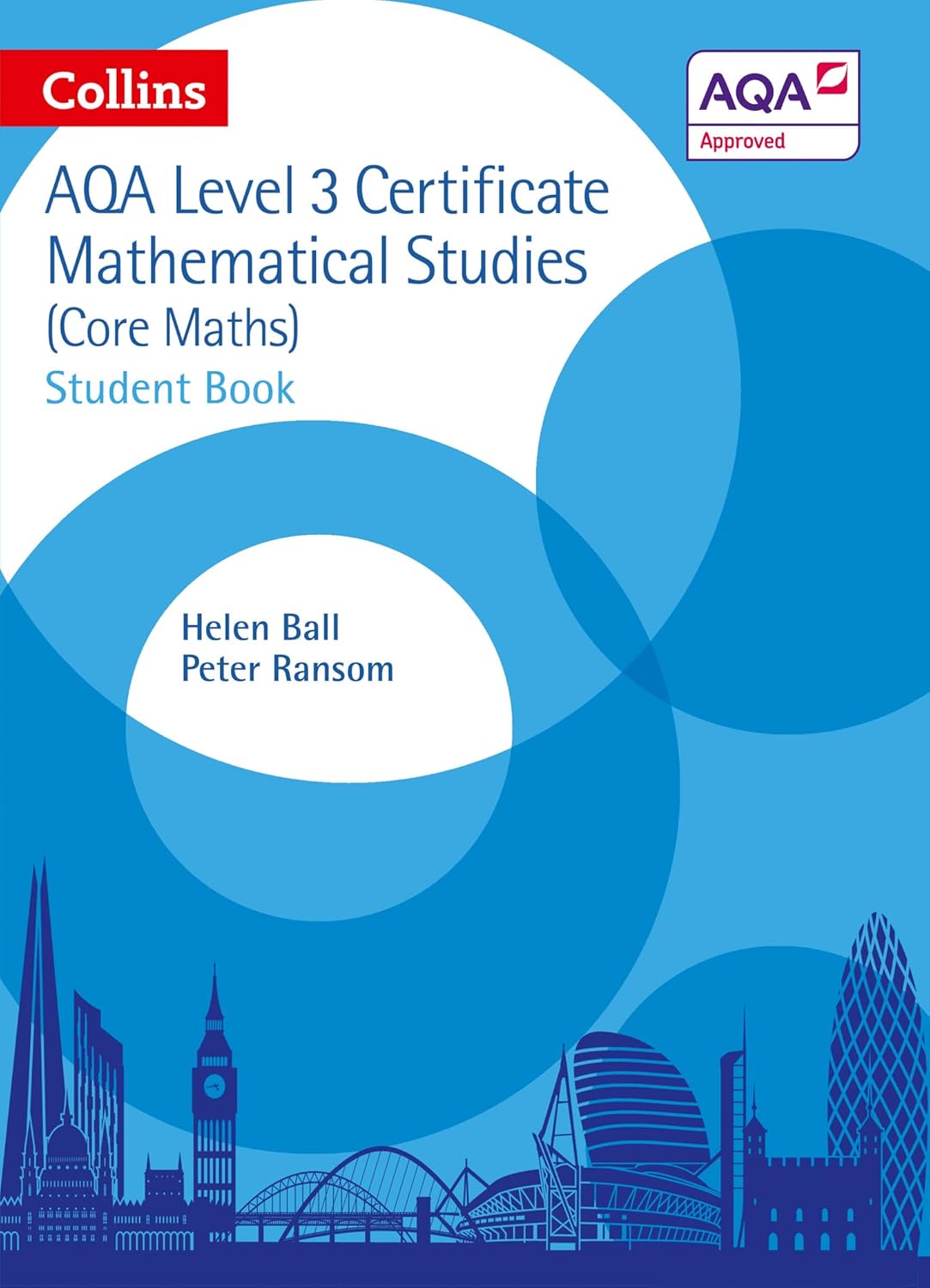
We have a class set of the textbook below:
Wider reading list:
- The Tiger That Isn't: Seeing Through a World of Numbers – Andrew Dilnot and Michael Blastland
- Why Do Buses Come in Threes?: The Hidden Maths of Everyday Life – Rob Eastaway and Jeremy Wyndham
- Humble Pi: A Comedy of Maths Errors – Matt Parker
- How to Make the World Add Up: Ten Rules for Thinking Differently About Numbers – Tim Harford
What websites are recommended?
- More or Less from the BBC – This programme is available as a Podcast and takes a critical approach to numbers and statistics in the news
- Nrich – A collection of tasks from the Nrich website relevant to Core Maths
- Risky Talk Podcast – A podcast with Professor Sir David Spiegelhalter; professor of the public understanding of risk